Common Reasons ALF License Applications Get Denied (And How to Avoid Them)
Applying for an Assisted Living Facility (ALF) license can feel overwhelming. You’ve invested time, money, and energy—only to receive a denial letter that doesn’t clearly explain what went wrong. The truth is, most ALF license denials are preventable.
Licensing agencies aren’t looking to reject applications. They’re looking for safe, compliant, and well-prepared facilities. When something is missing, unclear, or inconsistent, the application stalls—or worse, gets denied.
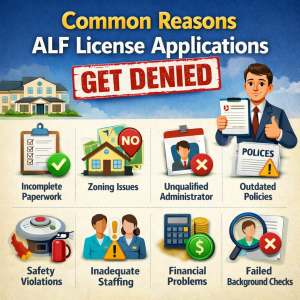
Let’s break down the most common reasons ALF license applications are denied and, more importantly, how you can avoid each one.
1. Incomplete or Incorrect Application Forms
This is the #1 reason applications get denied—and the easiest to prevent.
Many applicants rush through paperwork, assume sections don’t apply to them, or submit forms with missing signatures, unchecked boxes, or outdated versions.
Common mistakes include:
-
Leaving sections blank instead of writing “N/A”
-
Using old application forms
-
Missing required attachments
-
Inconsistent information across documents
How to avoid it:
-
Use the most current application packet from your state
-
Read every instruction line by line (yes, even the fine print)
-
Double-check names, addresses, and facility details for consistency
-
Have a second person review the entire application before submission
👉 A clean, complete application tells regulators you’re organized and serious.
2. Zoning and Local Approval Issues
You can have a perfect ALF setup and still get denied if your location isn’t approved.
Many applicants assume that because a house looks suitable, it’s automatically allowed to operate as an ALF. That’s not always true.
Problems often include:
-
Zoning does not allow assisted living use
-
Missing local occupancy approval
-
HOA restrictions
-
Fire or building department clearance not completed
How to avoid it:
-
Confirm zoning approval before applying for a license
-
Obtain written confirmation from local authorities
-
Check fire safety and occupancy limits early
-
Don’t rely on verbal approvals—get everything documented
3. Administrator Qualifications Don’t Meet Requirements
Your administrator is the backbone of your facility. If their qualifications don’t meet state requirements, the application can be denied—even if everything else is perfect.
Common issues:
-
Required administrator training not completed
-
Expired certificates
-
Administrator listed but not actually available full-time
-
Background screening incomplete or pending
How to avoid it:
-
Complete administrator training before submitting the application
-
Ensure certificates are current and state-approved
-
Verify background checks are cleared and documented
-
Make sure the administrator understands their role and responsibilities
4. Policies and Procedures That Don’t Match Regulations
This is a big one.
Many applicants submit generic, copied, or outdated policies that don’t reflect current state rules—or worse, contradict them.
Regulators can easily spot policies that were copied from the internet.
Red flags include:
-
Policies that reference the wrong state
-
Missing required policies (medication, emergencies, infections, abuse prevention)
-
Policies that don’t match actual operations
-
Overly vague or unrealistic procedures
How to avoid it:
-
Customize policies to your specific facility
-
Align every policy with state regulations
-
Make sure staff can actually follow what’s written
-
Update policies regularly before submission
👉 Policies should reflect what you will actually do, not what sounds good on paper.
5. Physical Plant and Safety Deficiencies
Your building must meet strict safety standards—and inspectors will notice even small issues.
Common facility problems:
-
Incorrect room sizes
-
Insufficient bathrooms
-
Missing handrails or grab bars
-
Unsafe flooring or lighting
-
Incomplete fire safety features
How to avoid it:
-
Review physical plant requirements carefully
-
Conduct a mock inspection before the official one
-
Fix minor issues early—they add up fast
-
Don’t assume older homes are automatically compliant
6. Inadequate Staffing Plan
Licensing agencies want proof that residents will receive proper care—not just now, but as occupancy increases.
Applications are often denied when:
-
Staffing ratios are unclear
-
Job roles are poorly defined
-
Overnight coverage is missing
-
No plan exists for staff absences or emergencies
How to avoid it:
-
Create a clear staffing schedule
-
Define roles and responsibilities in writing
-
Show how coverage will adjust as residents increase
-
Include training and supervision plans
7. Financial Documentation Problems
Yes—your finances matter.
Regulators want to ensure your facility can operate safely without cutting corners.
Issues include:
-
Insufficient proof of funds
-
Bank statements that don’t meet minimum requirements
-
Unclear financial responsibility
-
Missing operating budget or projections
How to avoid it:
-
Provide clear, recent financial documentation
-
Meet minimum reserve requirements
-
Ensure names on accounts match application details
-
Organize financial paperwork professionally
8. Background Screening Issues
Background checks are non-negotiable.
Applications may be denied due to:
-
Incomplete screenings
-
Disqualifying offenses
-
Incorrect submission process
-
Expired screening results
How to avoid it:
-
Start background checks early
-
Ensure all required individuals are screened
-
Follow state-specific screening procedures
-
Keep copies of all clearance documents
9. Poor Communication With the Licensing Agency
Silence can hurt your application.
Some applicants miss deadlines, ignore requests for additional information, or respond too late.
How to avoid it:
-
Respond promptly to all communications
-
Track deadlines carefully
-
Ask clarifying questions when unsure
-
Keep copies of every email and document submitted
Most ALF license denials don’t happen because applicants are unqualified. They happen because of missed details, assumptions, and lack of preparation.
The licensing process rewards:
-
Accuracy
-
Organization
-
Compliance
-
Professionalism
When you treat your application like a business launch—not just paperwork—you dramatically increase your chances of approval.